Interface DNA™
Integration identity, source and target context, patterns and technical characteristics.

INTRIXA Integration DNA™ is the fact-intelligence model used to place integration facts in context — connecting what exists, how it runs, what depends on what, and what the facts supports for transformation decisions.
Each domain contributes a distinct view. Together they create a traceable baseline without manufacturing certainty where facts is missing.
Integration identity, source and target context, patterns and technical characteristics.
Transformation-relevant characteristics, redesign drivers and implementation constraints supported by facts.
Runtime and lifecycle facts, with uncertainty kept explicit where operational proof is absent.
Modernization-relevant facts and context without prescribing a target answer.
Available risk facts and risk context kept explicit at interface level.
Fact-based fingerprint and identity characteristics used to distinguish and trace integration assets.
Facts relevant to housekeeping, cleanup and transformation-scope optimization.
Ownership, standards, authority and governance facts relevant to decision making.
Available security facts and the security context that needs consideration during transformation.
Relationships and topology context that reveal impact beyond an interface inventory alone.
Available business-domain context linked to the integration facts, with unsupported context kept explicit.
INTRIXA identifies customer integration artifacts in SAP PO, preserves their existing technical identity and derives fact-based naming recommendations using consistent governance patterns.
Customer Integration Artifact A
Existing technical identity preserved
Integration context retained
Facts-derived naming standard
Governed naming pattern
Status and traceability retained
Illustrative anonymized representation. No customer names, systems, artifacts or business identifiers are exposed.
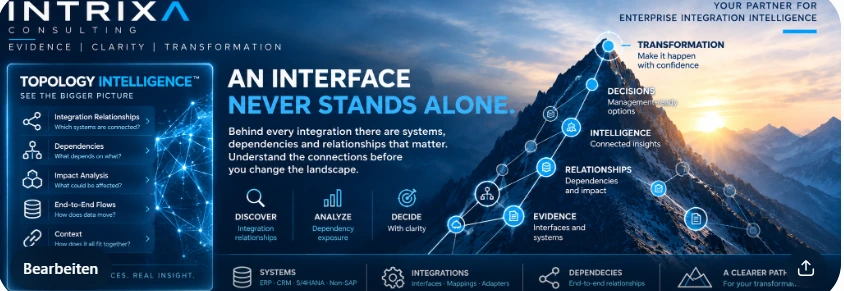
An interface list rarely reveals the full transformation context. Topology DNA™ helps expose the relationships that need to be understood before decisions are made.
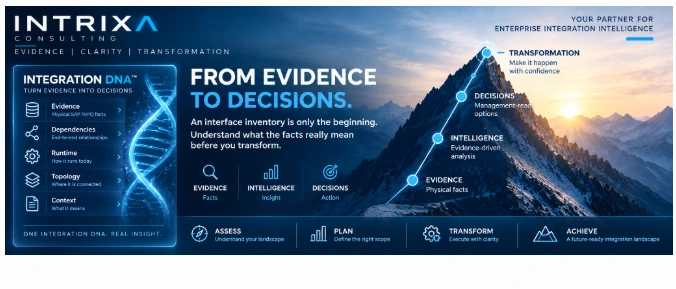
Understand the topology before deciding what to transform.